

What Two Parts Makeup The Michigan Legislature
| Michigan State Legislature | |
 | |
| General information | |
| Type: | Land legislature |
| Term limits: | ii terms (8 years) in Senate, 3 terms (6 years) in House |
| Session start: | January 12, 2022 |
| Website: | Official Legislature Page |
| Leadership | |
| Senate President: | Garlin Gilchrist Ii (D) |
| House Speaker: | Jason Wentworth (R) |
| Majority Leader: | Senate: Mike Shirkey (R) House: Ben Frederick (R) |
| Minority Leader: | Senate: Jim Ananich (D) House: Donna Lasinski (D) |
| Structure | |
| Members: | 38 (Senate), 110 (House) |
| Length of term: | 4 years (Senate), two years (House) |
| Authority: | Art IV, Michigan Constitution |
| Salary: | $71,685/year + expenses |
| Elections | |
| Concluding election: | November 3, 2020 |
| Next election: | Nov 8, 2022 |
| Redistricting: | Independent commission |
The Michigan Legislature is the land legislature of Michigan. It is organized as a bicameral institution consisting of the Michigan Senate, the upper business firm, and the Firm of Representatives, the lower house. Commodity IV of the Michigan Constitution, adopted in 1963, defines the function of the legislature and how it is to be constituted.[ane] The Michigan Legislature meets in the Capitol in Lansing, Michigan.
The Michigan Contained Citizens Redistricting Commission (MICRC) canonical new district boundaries for both the state Senate and state House of Representatives on December 28, 2021. The commission canonical what was known as the "Linden" map for country Senate districts past a vote of nine-four with ii Democrats, two Republicans, and all v nonpartisan members supporting the proposal. The commission adopted what was known equally the "Hickory" map for country House of Representatives districts past a vote of 11-2 with four Democrats, ii Republicans, and all v nonpartisan members supporting it.[2] [three] As required, the adopted map was approved by "at least two commissioners who affiliate with each major party, and at least ii commissioners who do not chapter with either major party."[4] The maps became law on March 26, 2022—60 days later on the MICRC published a written report on the redistricting plans with the secretary of country.[five] Click here for more information.
Michigan has a divided government where neither party holds a trifecta. The Democratic Party controls the function of governor, while the Republican Party controls both chambers of the state legislature.
-
- Run across as well: Michigan House of Representatives, Michigan Land Senate, Michigan Governor
Elections
2022
-
- Run into also: Michigan State Senate elections, 2022 and Michigan Business firm of Representatives elections, 2022
Elections for the Michigan State Senate volition take place in 2022. The full general election is on November viii, 2022. A primary is scheduled for August ii, 2022. The filing deadline was April 19, 2022.
Elections for the Michigan House of Representatives will take place in 2022. The general election is on November 8, 2022. A chief is scheduled for August ii, 2022. The filing deadline was April 19, 2022.
2020
-
- See also: Michigan House of Representatives elections, 2020
Elections for the office of Michigan House of Representatives took identify in 2020. Heading into the 2020 election, there were 58 Republicans, 51 Democrats, and one vacancy in the bedroom. The full general ballot was held on Nov 3, 2020. A primary was scheduled for August 4, 2020. The filing borderline was April 21, 2020.
2018
-
- See also: Michigan Country Senate elections, 2018 and Michigan House of Representatives elections, 2018
Elections for the Michigan Country Senate took place in 2018. The open primary election took place on August 7, 2018, and the general election was held on Nov 6, 2018. The candidate filing deadline was Apr 24, 2018.[6]
Elections for the Michigan Business firm of Representatives took identify in 2018. The open primary election took place on August 7, 2018, and the general ballot was held on November 6, 2018. The candidate filing deadline was
2016
-
- See likewise: Michigan Firm of Representatives elections, 2016
Elections for the Michigan House of Representatives took place in 2016. The main election was held on August two, 2016, and the full general election was held on November 8, 2016. The candidate filing deadline was April 19, 2016.
2014
-
- See as well: Michigan State Senate elections, 2014 and Michigan House of Representatives elections, 2014
Elections for the Michigan State Senate took identify in 2014. A primary election was held on August 5, 2014, and a general election took place on Nov 4, 2014. The signature filing deadline for candidates wishing to run in this election was April 22, 2014.
Elections for the Michigan House of Representatives took place in 2014. A chief ballot was held on August 5, 2014, and a full general election was held on November 4, 2014. The signature filing deadline for candidates wishing to run in this ballot was April 22, 2014.
2012
-
- See as well: Michigan House of Representatives elections, 2012
Elections for the office of Michigan House of Representatives took place in 2012. The master ballot was held on August 7, 2012, and the general election was held on November 6, 2012. The candidate filing borderline was May 12, 2012.
2010
-
- See as well: Michigan State Senate elections, 2010 and Michigan House of Representatives elections, 2010
Elections for the office of Michigan State Senate took place in 2010. The chief election was held on Baronial 3, 2010, and the full general election was held on November ii, 2010. The candidate filing deadline was May 11, 2010.
Elections for the office of Michigan Firm of Representatives took place in 2010. The primary ballot was held on Baronial three, 2010, and the general election was held on Nov 2, 2010. The candidate filing deadline was May 11, 2010.
Sessions
The Michigan Legislature, according to Article 4 Section xiii of the Michigan constitution, must convene by noon on the second Wednesday in January. The Legislature is at liberty to choose when to curb, though all bills carry over into the next session.[eight]
2022
-
- Come across also: 2022 Michigan legislative session and Dates of 2022 state legislative sessions
In 2022, the legislature was scheduled to convene on January 12, 2022, and curb on December 31, 2022.
2021
-
- Meet as well: 2021 Michigan legislative session and Dates of 2021 state legislative sessions
In 2021, the legislature was scheduled to convene on January 13, 2021, and adjourn on December 31, 2021.
2020
-
- See likewise: 2020 Michigan legislative session and Dates of 2020 state legislative sessions
In 2020, the legislature was scheduled to convene on January 8, 2020, and adjourn on December 31, 2020.
-
- Come across as well: Changes to state legislative session dates in response to the coronavirus (COVID-19) pandemic, 2020
 |
|---|
| Coronavirus pandemic |
| Select a topic from the dropdown below to learn more than. |
Several state legislatures had their sessions impacted as a result of the 2020 coronavirus pandemic. No modifications to state legislative activity in Michigan were fabricated.
A special session of the Michigan Land Legislature convened on April 24, 2020.[9]
2019
-
- Come across also: 2019 Michigan legislative session and Dates of 2019 state legislative sessions
In 2019, the legislature was in session from Jan 9, 2019, through December 31, 2019.
2018
-
- See also: 2018 Michigan legislative session and Dates of 2018 land legislative sessions
In 2018, the legislature was in session from January 10, 2018, through December 31, 2018. To read about notable events and legislation from this session, click hither.
2017
-
- Come across also: Dates of 2017 country legislative sessions
In 2017, the legislature was in session from January 11, 2017, through Dec 31, 2017.
| Click [show] to read nearly 2017 tax incentives legislation. |
|---|
|
| Click [bear witness] for past years' session dates. |
|---|
2016
In 2016, the legislature was in session from January 13 through Dec 31. 2015
In 2015, the legislature was in session from Jan xiv through December 17. Major issues in 2015Major issues in the 2015 legislative session included free energy policy and a possible repeal of the state's prevailing wage law.[14] [xv] 2014
In 2014, the legislature was in session from January eight through December 31. Major issues in 2014Major problems in the 2014 legislative session included allocation of an estimated $971 million surplus over three years, which some Republicans said should go towards a revenue enhancement reduction.[sixteen] [17] 2013
In 2013, the legislature was in session from January 9 to December 31. Major problems in 2013Major issues included the regulatory structure of Bluish Cross Bluish Shield of Michigan, increased transportation funding, education, and alimony changes.[18] 2012
In 2012, the legislature was in session from January 11 to Dec 27. 2011In 2011, the legislature was in session from January 12 through December 28. Session highlightsTax reformIn the 2011 session, Michigan was a key battleground on corporate taxes. Governor Rick Snyder (R) had said during his campaign he would eliminate the "Michigan Business organisation Taxation." Governor Snyder replaced the tax with a flat vi percent corporate income revenue enhancement.[nineteen] 2010In 2010, the legislature convened its session on January 13th, and information technology remained in session throughout the year. |
Role in state upkeep
-
- See besides: Michigan country budget and finances
The state operates on an annual budget cycle. The sequence of key events in the budget process is as follows:[20]
- Upkeep instructions are sent to state agencies in Baronial of the yr preceding the commencement of the new fiscal year.
- Country agencies submit their requests to the governor in October.
- Agency hearings are held in Oct.
- The governor submits his or her proposed upkeep to the land legislature in Feb. Newly elected governors are allowed an additional thirty to 60 days after the legislature convenes.
- The legislature typically adopts a budget in June. The fiscal twelvemonth begins Oct 1.
Michigan is one of 44 states in which the governor has line item veto authority.[xx]
The governor is constitutionally required to submit a balanced budget proposal. Likewise, the state legislature is required to laissez passer a counterbalanced upkeep.[20]
Senate
The Senate is the upper firm of the Legislature. Its members are elected on a partisan basis for four-year terms concurrent with the ballot of the governor of Michigan. The Senate consists of 38 members elected from single-member election districts.
As of the 2020 Census, Michigan state senators represented an average of 265,192 residents. Afterward the 2010 Census, each member represented 260,095 residents.
The Senate chamber in the Country Capitol is located in the south wing of the building. Nether the Michigan Constitution, the lieutenant governor of Michigan serves as President of the Senate just may only bandage a vote in the instance of a necktie.[21] The Senate selects its other officers and adopts its own rules of procedure at the start of a new legislative session.[22]
| Party | Every bit of June 2022 | |
|---|---|---|
| Autonomous Party | 16 | |
| Republican Political party | 22 | |
| Vacancies | 0 | |
| Total | 38 | |
Click here for a list of members of this bedroom.
From 1990 to 2019, the Michigan State Senate was controlled past the Republican Party. The table below shows the partisan history of the Michigan State Senate following every general election from 1990 to 2018. All data from 2006 or before comes from Michael Dubin's Political party Affiliations in the Country Legislatures (McFarland Press, 2007). Data after 2006 was compiled by Ballotpedia staff.
Michigan Land Senate Party Control: 1990-2018
| Twelvemonth | 'ninety | '94 | '98 | '02 | '06 | '10 | '14 | '18 |
|---|---|---|---|---|---|---|---|---|
| Democrats | xviii | 16 | 15 | sixteen | 17 | 12 | 11 | 16 |
| Republicans | xx | 22 | 23 | 22 | 21 | 26 | 27 | 22 |
Republicans maintained command of the Michigan State Senate from 1990 to 2019. Throughout the menses, Democrats usually controlled between 11 and 18 seats, while Republicans controlled betwixt 20 and 27 seats. Senate Republicans held their largest majority following the 2014 elections when Republicans held a sixteen-seat advantage. From the 2010 elections through the 2014 elections, Republicans held more than than the 26 seats required to override a gubernatorial veto. The Republican gains from 2010 to 2014 were in line with a national trend toward Republican state legislatures during the presidency of Barack Obama (D). From 2009 to 2017, Democrats experienced losses in state legislative elections, totaling 968 seats all together.
House of Representatives
The House of Representatives is the lower business firm of the Legislature. Its members are elected on a partisan ground for ii-year terms at the same time at which members of Congress are chosen. The Business firm of Representatives consists of 110 members who are elected from single-member election districts.
As of the 2020 Census, Michigan land representatives represented an average of 91,612 residents. After the 2010 Census, each member represented 89,851 residents.
The House of Representatives chamber in the Capitol is located in the northward fly of the building. The House of Representatives selects its own Speaker of the House and other officers and adopts its rules of process at the start of a new legislative session.[23]
| Party | As of June 2022 | |
|---|---|---|
| Autonomous Party | 53 | |
| Republican Political party | 57 | |
| Vacancies | 0 | |
| Total | 110 | |
Click here for a list of members of this bedroom.
Betwixt 1992 and 2010, partisan control of the Michigan House of Representatives fluctuated, swinging back and forth between the Autonomous and Republican parties. Since the 2010 elections, Republicans have controlled the sleeping room. The tabular array below shows the partisan history of the Michigan House of Representatives following every general ballot from 1992 to 2020. All data from 2006 or earlier comes from Michael Dubin'south Political party Affiliations in the Land Legislatures (McFarland Printing, 2007). Data after 2006 was compiled by Ballotpedia staff.
Michigan House of Representatives Party Control: 1992-2020
| Yr | '92 | '94 | '96 | '98 | '00 | '02 | '04 | '06 | '08 | 'x | '12 | '14 | '16 | 'xviii | '20 |
|---|---|---|---|---|---|---|---|---|---|---|---|---|---|---|---|
| Democrats | 55* | 54 | 58 | 52 | 51 | 47 | 52 | 58 | 67 | 47 | 51 | 47 | 47 | 52 | 52 |
| Republicans | 55 | 56 | 52 | 58 | 59 | 63 | 58 | 52 | 43 | 63 | 59 | 63 | 63 | 58 | 58 |
*Chamber controlled by ability-sharing understanding
Betwixt 1992 and 2020, majority command of the state House changed half dozen times. Every bit a consequence of the 1992 elections, the chamber was tied at 55-55. A ability-sharing understanding was reached between Democrats and Republicans where leadership of the bedchamber switched every month.[24] Republicans gained an outright majority in the 1994 elections when the party gained one seat. Republicans held the sleeping room until the 1996 elections when Democrats gained four seats and held a 58-52 bulk. Republicans regained command of the chamber in the 1998 elections and held the chamber until the 2006 elections. During that period of time, the Republican majority spiked following the 2002 elections when the party held a 63-47 majority. Republicans lost v seats in the 2004 elections but maintained command of the chamber.
Democrats took command of the House in the 2006 elections and held the sleeping room until the 2010 elections. In the 2008 elections, Democrats increased their majority from 58-52 to 67-43. In the 2010 elections, Republicans took control of the legislature after they flipped both chambers.[25] The Republican gains in 2010 were in line with a national tendency toward Republican land legislatures during the presidency of Barack Obama (D). From 2009 to 2017, Democrats experienced losses in state legislative elections, totaling 968 seats altogether. Between 1992 and 2020, Democrats commonly controlled between 47 and 67 seats, while Republicans controlled between 43 and 63 seats. From 1992 to 2020, neither Democrats or Republicans held more the 74 seats required to override a gubernatorial veto.
District maps
Land Senate
The map beneath shows this district's current boundaries, not those enacted equally office of the 2020 redistricting cycle.
State Firm
The map below shows this district's current boundaries, not those enacted as part of the 2020 redistricting bicycle.
Veto overrides

-
- Meet also: Veto overrides in land legislatures
State legislatures tin can override governors' vetoes. Depending on the state, this can be done during the regular legislative session, in a special session post-obit the adjournment of the regular session, or during the next legislative session. The rules for legislative overrides of gubernatorial vetoes in Michigan are listed beneath.
How many legislators are required to vote for an override? Two-thirds of members in both chambers.
Two-thirds of members in both chambers must vote to override a veto, which is 74 of the 110 members in the Michigan House of Representatives and 26 of the 38 members in the Michigan State Senate. Michigan is 1 of 36 states that requires a two-thirds vote from both of its legislative chambers to override a veto.
Say-so: Commodity Iv, Section 33 of the Michigan Constitution.
"Every pecker passed by the legislature shall be presented to the governor before it becomes police force, and the governor shall take 14 days measured in hours and minutes from the time of presentation in which to consider it. If he approves, he shall within that fourth dimension sign and file it with the secretary of state and it shall become police force. If he does non corroborate, and the legislature has within that time finally adjourned the session at which the bill was passed, information technology shall not go law. If he disapproves, and the legislature continues the session at which the pecker was passed, he shall render information technology within such fourteen-24-hour interval period with his objections, to the firm in which it originated. That business firm shall enter such objections in total in its journal and reconsider the bill. If two-thirds of the members elected to and serving in that business firm pass the bill yet the objections of the governor, it shall exist sent with the objections to the other house for afterthought. The bill shall become law if passed by two-thirds of the members elected to and serving in that house."
History
Partisan residuum 1992-2013

-
- Run across as well: Ballotpedia:Who Runs u.s.a. and Ballotpedia:Who Runs the states, Michigan
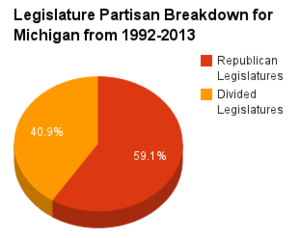
Partisan breakdown of the Michigan legislature from 1992-2013
Michigan State Senate: During every year from 1992-2013, the Republican Party was the majority in the Michigan Land Senate. The Michigan Land Senate is one of 13 state senates that was Republican for more than fourscore pct of the years between 1992-2013. For the final three years of the study Michigan was under Republican trifectas.
Across the country, in that location were 541 Democratic and 517 Republican state senates from 1992 to 2013.
Michigan State House of Representatives: From 1992-2013, the Republican Party was the majority in the Michigan State House of Representatives for xiii years while the Democrats were the majority for seven years. For the last iii years of the written report Michigan was under Republican trifectas.
Across the country, at that place were 577 Democratic and 483 Republican Land Houses of Representatives from 1992 to 2013.
Over the course of the 22-year study, state governments became increasingly more partisan. At the starting time of the study menstruum (1992), 18 of the 49 states with partisan legislatures had single-political party trifectas and 31 states had divided governments. In 2013, just 13 states had divided governments, while single-party trifectas held sway in 36 states, the most in the 22 years studied.
The chart below shows the partisan composition of the Office of the Governor of Michigan, the Michigan State Senate and the Michigan Firm of Representatives from 1992 to 2013.

SQLI and partisanship
-
- To read the full report on the State Quality of Life Index (SQLI) in PDF form, click here.
The chart below depicts the partisanship of the Michigan state authorities and the state's SQLI ranking for the years studied. For the SQLI, us were ranked from one-50, with 1 being the all-time and 50 the worst. Michigan has had spurts of divided government and a Republican trifecta. The state had a Republican trifecta during three split up periods (1995-1996, 1999-2002, and 2011-2013) and divided authorities during three separate periods (1992-1994, 1997-1998, and 2003-2010). The state'south highest SQLI ranking came in 1999 nether a Republican trifecta (19th). Starting time in 2007, Michigan has slipped into the lesser-10 of the SQLI ranking and has remained there since. Michigan saw its near precipitous drop in the SQLI ranking between 2001 and 2002 and again between 2003 and 2004, under both a Republican trifecta and divided government, respectively. The state had non had a Democratic trifecta.
- SQLI average with Autonomous trifecta: N/A
- SQLI average with Republican trifecta: 26.88
- SQLI average with divided authorities: 33.31

Nautical chart displaying the partisanship of Michigan government from 1992-2013 and the State Quality of Life Index (SQLI).
Redistricting
-
- See also: Redistricting in Michigan
In Michigan, a non-politician commission is responsible for drawing both congressional and state legislative district plans. The commission comprises 13 members, including iv Democrats, 4 Republicans, and 5 unaffiliated voters or members of minor parties. In order for a map to be enacted, at least seven members must vote for it, including at least two Democrats, two Republicans, and ii members not affiliated with either major party.[26]
The Michigan Independent Citizens Redistricting Commission prepared this document specifically explaining the redistricting process later on the 2020 census.
2020
-
- Encounter also: Redistricting in Michigan after the 2020 census
The Michigan Independent Citizens Redistricting Commission (MICRC) approved new commune boundaries for both the state Senate and state Firm of Representatives on December 28, 2021. The commission approved what was known as the "Linden" map for state Senate districts by a vote of 9-4 with two Democrats, 2 Republicans, and all five nonpartisan members supporting the proposal. The commission adopted what was known as the "Hickory" map for land House of Representatives districts by a vote of 11-2 with iv Democrats, ii Republicans, and all five nonpartisan members supporting it.[2] [27] As required, the adopted map was approved past "at to the lowest degree two commissioners who affiliate with each major party, and at least two commissioners who do non chapter with either major political party."[4] The maps became police force on March 26, 2022—60 days later the MICRC published a written report on the redistricting plans with the secretary of state.[v]
According to The Detroit News, The Linden Senate map...is expected to create districts that could yield 20 Autonomous seats and 18 Republican seats. Senate Republicans currently have a 22-16 bulk."[2] Clara Hendrickson of the Detroit Free Printing wrote that, "The map appears to create nineteen solidly Autonomous districts, 16 solidly Republican districts, one Republican-leaning district and two toss-up districts, according to election results from the past decade."[28]
Beth LeBlanc of The Detroit News wrote that, "The Hickory House map...is expected to create districts that could produce 57 Autonomous seats and 53 Republican seats. After the 2020 ballot, Michigan Firm Republicans had a 58-52 majority in the Firm."[2] Hendrickson wrote that, "The new map appears to create 41 solidly Democratic districts, 46 solidly Republican districts, nine Democratic-leaning districts, ii Republican-leaning districts and 12 toss-up districts."[28] She likewise wrote, "Unlike the current map, at that place is no bulk-Black district in the state Senate map adopted past the commission, while the country House map reduces the number of majority-Black districts in place today. Current and old land lawmakers from Detroit and civil rights leaders are vehemently opposed to how the new district lines reduce the share of Black voters. They debate that the elimination of majority-Blackness districts disenfranchises Black voters."[28] These maps take result for Michigan'southward 2022 legislative elections.
2010
-
- Run across as well: Redistricting in Michigan after the 2010 demography
According to the U.S. Demography Bureau, Michigan's population savage from 9.94 million to 9.88 million between 2000 and 2010.[29] Michigan'due south U.S. Congressional delegation decreased in size from 15 to 14 seats.[thirty] A substantial population shift occurred from Detroit proper into the suburban areas.[31]
A Republican-proposed redistricting plan passed with bipartisan support later on the House made some changes to the Senate programme. Governor Rick Snyder (R) signed the programme, Senate Bill 498, into police force on August 9, 2011.
Legislators
Salaries
-
- Meet also: Comparison of state legislative salaries
| State legislators | |
|---|---|
| Salary | Per diem |
| $71,685/year | No per diem is paid. Legislators receive an expense allowance of $10,800/year for session and acting. Ready past the compensation commission. Vouchered. |
Swearing in dates
-
- Run across as well: When land legislators presume office afterward a full general election
Michigan legislators assume role at apex on the commencement day of January.[32]
Terms and sessions
Every two years the entire House of Representatives stands for election, whereas the Senate does then at four-twelvemonth intervals concurrently with elections for Governor. Each two-year menstruum coinciding with the ballot of new members of the Firm of Representatives is numbered consecutively equally a "Legislature" dating to the beginning legislature following Michigan's admission as a state.
Each year during which the legislature meets constitutes a "session" of the Legislature. According to the state's constitution, Article IV Section 13, a new session of the legislature begins when the members of each house convene on the second Midweek of Jan every year at noon. A regular session of the Legislature typically lasts throughout the unabridged year with several periods of recess and adjourns sine dice in December.
Any legislation pending in either business firm at the cease of a session that is not the end of a legislative term of office continues and carries over to the next legislative session.
Term limits
-
- Run across also: State legislatures with term limits
The Michigan legislature is 1 of 15 land legislatures with term limits. Voters enacted the Michigan Term Limits Act in 1992. Michigan senators are subject to term limits of no more than than two four-year terms, or a total of eight years. Senators who have not served more than than one-half of someone else'southward Senate term are eligible for 2 total terms (eight years). Michigan representatives are bailiwick to term limits of no more than than three two-twelvemonth terms, or a total of six years.[33] The first yr that the term limits enacted in 1992 impacted the ability of incumbents to run for role was in 2002.
Joint legislative committees
-
- See also: Public policy in Michigan
The Michigan State Legislature has no joint standing committees.
Constitutional amendments
In every state but Delaware, voter approval is required to enact a constitutional amendment. In each state, the legislature has a process for referring ramble amendments before voters. In xviii states, initiated constitutional amendments can exist put on the ballot through a signature petition drive. In that location are also many other types of statewide measures.
The methods in which the Michigan Constitution can be amended:
-
- See besides: Article XII of the Michigan Constitution and Laws governing ballot measures in Michigan
The Michigan Constitution can exist amended in these ways:
- An subpoena can go before voters as a legislatively referred constitutional amendment as established in Section 1 of Article XII.
-
- These tin be proposed in either chamber of the Michigan State Legislature.
- Proposed amendments must be agreed to by ii-thirds of the members elected to and serving in each business firm before they are presented to voters.
- Elections on proposed amendments tin accept place on general ballot days or at a special election.
- The power of initiative can be used to put an initiated constitutional amendment on a statewide election as established in Section 2 of Commodity XII.
-
- valid signatures equal to 10 per centum of the votes cast in the last gubernatorial election are required to put a proposed constitutional subpoena on the ballot through the power of initiative.
- The proposed amendment is enacted if a bulk of voters voting on the amendment approve of it.
- A constitutional convention, as established in Section 3 of Commodity XII, can exist called to advise amendments, as well every bit extensive revisions, to the state'due south constitution.
-
- A question about whether to hold a constitutional convention automatically appears on the state's ballot every sixteen years.
2023 measures:
-
- See likewise: 2023 ballot measures
Certified:
- The following measures accept been certified for the ballot.
No measures to listing
Potential:
- The following measures have made information technology through ane sleeping accommodation—or one session for two session states—and may appear on the ballot in 2023.
No measures to list
2022 measures:
Below is a list of measures that were referred to the 2022 ballot by the legislature or that have made it approximately halfway through the process in the legislature for referral to the ballot in 2022.
-
- Come across as well: Michigan 2022 ballot measures
Certified:
- The post-obit measures have been certified for the ballot.
| Michigan Legislative Term Limits and Financial Disclosure Subpoena | Democrats | Republicans | |||
| Senate: | Required: 26 | Yes votes: 26 (68.42%) | No votes: 6 (15.79%) | Aye: ###; No: ### | Yes: ###; No: ### |
| Business firm: | Required: 73 | Yes votes: 76 (69.73%) | No votes: 28 (25.68%) | Yep: ###; No: ### | Aye: ###; No: ### |
Potential:
- The following measures have made it through 1 chamber—or one session for 2 session states—and may announced on the ballot in 2022.
| Michigan Two-Thirds Legislative Vote on Lame-Duck Session Bills Amendment | Democrats | Republicans | |||
| Senate: | Required: | Yes votes: (%) | No votes: (%) | Yes: ; No: | Yes: ; No: |
| House: | Required: | Yes votes: (%) | No votes: (%) | Yes: ; No: | Yeah: ; No: |
| Michigan Ceremonious Service Employee Legislative Advice Amendment | Democrats | Republicans | |||
| Senate: | Required: | Yes votes: (%) | No votes: (%) | Yes: ; No: | Yes: ; No: |
| Firm: | Required: | Yes votes: (%) | No votes: (%) | Aye: ; No: | Yes: ; No: |
| Michigan Legislative Vote to Suspend Legislator'south Bacon Amendment | Democrats | Republicans | |||
| Senate: | Required: | Yes votes: (%) | No votes: (%) | Yeah: ; No: | Yes: ; No: |
| House: | Required: | Yeah votes: (%) | No votes: (%) | Yes: ; No: | Yeah: ; No: |
See also
| Elections | Michigan State Government | State Legislatures | Country Politics |
|---|---|---|---|
| | | | |
|
|
|
|


External links
- Michigan Legislature
- Michigan Business firm of Representatives
- Michigan Senate
Footnotes
- ↑ Michigan Legislature, "Constitution of the Land of Michigan," accessed February 12, 2021
- ↑ ii.0 ii.1 2.two 2.iii The Detroit News, "Michigan redistricting panel wraps adoption of country House, Senate, congressional maps" December 28, 2021
- ↑ Detroit Free Printing, "Michigan redistricting commission adopts new state legislative maps," December 28, 2021
- ↑ four.0 4.1 Michigan Legislature, "Commodity Four § 6" - Independent citizens redistricting commission for state legislative and congressional districts," accessed Jan 3, 2022
- ↑ 5.0 five.ane Cite fault: Invalid
<ref>tag; no text was provided for refs namedMICRCemail - ↑ Michigan.gov, "2018 Michigan election dates," accessed November 9, 2017
- ↑ Michigan.gov, "2018 Michigan election dates," accessed Nov nine, 2017
- ↑ Michigan Legislature, "Constitution of the Country of Michigan," accessed February 12, 2021
- ↑ Michigan Radio, "Lawmakers render to Lansing Friday for special session," accessed April 25, 2020
- ↑ Detroit Complimentary Press, "Michigan Senate approves more tax breaks for businesses," March 29, 2017
- ↑ Michigan.gov, "Gov. Rick Snyder'due south statement regarding passage of Good Jobs legislation," July 12, 2017
- ↑ Fox2Detroit, "Snyder signs bill to requite tax breaks for Michigan jobs," July 26, 2017
- ↑ MLive.com, "'Good Jobs' bills for new business organisation tax incentives heads to governor," July 12, 2017
- ↑ MLive, "Q&A with Senate Bulk Leader Arlan Meekhof: Energy policy, prevailing wage repeal on agenda," Jan 20, 2015
- ↑ MLive, "Michigan Republicans making new button for prevailing wage repeal in state Legislature," January 15, 2015
- ↑ Crain's Detroit Business, "Mich. has nigh $1B more than expected for upkeep," January 10, 2014
- ↑ Detroit Costless Press, "Michigan GOP puts tax break atop 2014 calendar, Bolger says," January ix, 2014
- ↑ Southward Bend Tribune, "Michigan Legislature starts tamer 2-year session today," January 9, 2013
- ↑ MLive, "Gov. Rick Snyder signs Michigan business/income tax overhaul into law," May 25, 2011
- ↑ 20.0 20.1 20.2 National Association of State Budget Officers, "Budget Processes in the States, Leap 2015," accessed February v, 2021
- ↑ Michigan Legislature, "Constitution of the State of Michigan," accessed February 12, 2021
- ↑ Michigan Legislature, "Senate Rules," accessed February 12, 2021 (Referenced Ch. ane, Sec. 1)
- ↑ Michigan Legislature, "Continuing Rules of the Michigan House of Representatives," accessed Feb 12, 2021
- ↑ NCSL, "IN Example OF A Tie......," accessed February 12, 2021
- ↑ Washington Postal service, "The Republican takeover in united states," November 14, 2010
- ↑ Michigan Radio, "Redistricting proposal passes in Michigan," Nov vi, 2018
- ↑ Detroit Complimentary Press, "Michigan redistricting commission adopts new country legislative maps," December 28, 2021
- ↑ 28.0 28.1 28.ii Detroit Free Press, "Michigan redistricting commission adopts new country legislative maps," December 28, 2021
- ↑ U.S. Census Bureau, "2010 Census: Michigan Profile," accessed February 12, 2021
- ↑ The Hill, "Longtime Dem Reps. Levin and Dingell could confront redistricting danger", December 22, 2010
- ↑ [https://roseinstitute.org/redistricting/michigan/ Rose Constitute of State and Local Government, " Michigan," accessed Feb 12, 2021]
- ↑ Michigan Constitution, "Commodity XI, Section 2," accessed February 12, 2021
- ↑ Michigan in Brief: 2002–03, "Executive Branch," accessed Feb 12, 2021
| State legislatures | ||
|---|---|---|
| Legislatures | Alabama (H, S)· Alaska (H, S)· Arizona (H, South)· Arkansas (H, S)· California (A, S)· Colorado (H, Southward)· Connecticut (H, Due south)· Delaware (H, S)· Florida (H, S)· Georgia (H, S)· Hawaii (H, S)· Idaho (H, South)· Illinois (H, Due south)· Indiana (H, S)· Iowa (H, S)· Kansas (H, S)· Kentucky (H, S)· Louisiana (H, S)· Maine (H, S)· Maryland (H, Due south)· Massachusetts (H, S)· Michigan (H, South)· Minnesota (H, South)· Mississippi (H, Due south)· Missouri (H, S)· Montana (H, Due south)· Nebraska· Nevada (A, Southward)· New Hampshire (H, S)· New Jersey (GA, S)· New Mexico (H, Due south)· New York (A, S)· North Carolina (H, S)· Northward Dakota (H, S)· Ohio (H, S)· Oklahoma (H, S)· Oregon (H, S)· Pennsylvania (H, Due south)· Rhode Island (H, S)· Due south Carolina (H, Due south)· South Dakota (H, S)· Tennessee (H, Due south)· Texas (H, S)· Utah (H, Due south)· Vermont (H, S)· Virginia (H, S)· Washington (H, S)· West Virginia (H, Due south)· Wisconsin (A, S)· Wyoming (H, S) | |
| 2022 | Land legislative elections (2022) • State legislative special elections (2022) • Primary dates and filing requirements • 2022 Session Dates | |
| 2021 | State legislative elections (2021) • Country legislative special elections (2021) • Principal dates and filing requirements • 2021 Session Dates | |
| Historical elections | 2020 • 2019 • 2018 • 2017 • 2016 • 2015 • 2014 • 2013 • 2012 • 2011 • 2010 • 2009 • 2008 • 2007 • 2006 • 2005 • 2004 • 2003 • 2002 • 2001 • 2000 | |
| Features of state legislatures | How vacancies are filled in state legislatures • States with a full-time legislature • State legislatures with term limits • Comparison of state legislative salaries • When state legislators assume part after a full general election • Population represented by state legislators • State ramble articles governing state legislatures • Country legislative sessions • Resign-to-run police • Country legislature candidate requirements by state • Official names of state legislatures • Land legislative chambers that use multi-member districts • Factors Affecting Competitiveness in Country Legislative Elections | |
| State senates | Length of terms of state senators • State senators • Partisan composition of state senates • State senators sorted by year first elected | |
| State houses | Length of terms of state representatives • State representatives • Partisan composition of country houses • Country representatives sorted by yr first elected | |
| Leadership positions | President of the Senate • President Pro Tempore • Senate Bulk Leader • Senate Minority Leader • House Majority Leader • House Minority Leader • State Speaker of the House | |

| Ballotpedia | |
|---|---|
| Nearly | Overview • What people are saying • Support Ballotpedia • Contact • Contribute • Chore opportunities |
| Executive: Leslie Graves, President • Gwen Beattie, Chief Operating Officer • Ken Carbullido, Vice President of Ballot Product and Technology Strategy Communications: Alison Graves • Megan Brown • Abigail Campbell • Sarah Groat • Lauren Nemerovski Contributors: Scott Rasmussen | |
| Editorial | Geoff Pallay, Editor-in-Primary • Daniel Anderson, Managing Editor • Ryan Byrne, Managing Editor • Cory Eucalitto, Managing Editor • Mandy Gillip, Managing Editor • Jerrick Adams • Victoria Antram • Dave Beaudoin • Jaclyn Beran • Marielle Bricker • Kate Carsella • Kelly Coyle • Megan Feeney • Nicole Fisher • Juan García de Paredes • Sara Horton • Tyler Male monarch • Doug Kronaizl • Amee LaTour • David Luchs • Brittony Maag • Roneka Matheny • Andrew McNair • Jackie Mitchell • Elisabeth Moore • Ellen Morrissey • Mackenzie Murphy • Samantha Post • Paul Rader • Ethan Rice • Myj Saintyl • Maddie Sinclair Johnson • Abbey Smith • Janie Valentine • Caitlin Vanden Boom • Joel Williams • Samuel Wonacott • Mercedes Yanora |
Source: https://ballotpedia.org/Michigan_State_Legislature
Posted by: herseythearded.blogspot.com
0 Response to "What Two Parts Makeup The Michigan Legislature"
Post a Comment